Now Hiring Plumbers & Electricians - Apply Today!

The Benefits of Whole Home Surge Protection in Manassas and Fairfax County
If you have lived in Manassas or Fairfax County for a few seasons, you know exactly how quickly a beautiful afternoon can turn into a dramatic summer thunderstorm. The sky turns a bruised purple, the wind picks up, and before you know it, the power flickers or cuts out entirely. While we often focus on the inconvenience of sitting in the dark, the real danger is what happens when that power tries to come back on. A single spike of high-voltage electricity can travel through your utility lines and into your home in a fraction of a second. For the modern Northern Virginia family, this is not just about a few light bulbs burning out. Our homes are now filled with sensitive, high-end electronics that serve as the backbone of our daily lives, from our home offices to our smart kitchen appliances.
In this guide, we’ll explore why whole-home surge protection is no longer a luxury but a necessity for homeowners in our region.
What Exactly is a Power Surge? (It’s Not Just Lightning)
When people hear the term “power surge,” they almost always picture a massive bolt of lightning striking a transformer. While a direct strike is certainly the most dramatic cause of an electrical spike, it is actually the least common. A power surge is simply a sudden, brief increase in voltage that significantly exceeds the standard 120 volts running through your home’s outlets. In Northern Virginia, our power grid is constantly balancing the load between residential neighborhoods, massive data centers, and commercial hubs. This balancing act can lead to small, frequent fluctuations that you might never even notice until a piece of equipment suddenly stops working.
In our experience serving Manassas and Fairfax, we find that most damaging surges actually come from within the house or from routine utility activity. Here are the most common sources of electrical spikes in our area:
- Major Appliance Cycling: When high-draw appliances like your air conditioner, refrigerator, or heat pump kick on, they briefly demand a huge amount of electricity, which can cause a momentary “kickback” surge to other devices on the same circuit.
- Utility Grid Switching: Dominion Energy or Northern Virginia Electric Cooperative (NOVEC) may switch power loads between different parts of the grid to manage demand, creating small spikes as the current stabilizes.
- Downed Power Lines: Winter ice storms or falling branches in heavily wooded Fairfax neighborhoods can cause lines to touch or break, sending a massive jolt through the system.
- Internal Wiring Issues: Damaged or outdated wiring can create “noise” and small surges as electricity struggles to flow smoothly through the house.
- Lightning: While rare, a nearby strike can travel through phone, cable, or power lines, delivering enough energy to melt the internal components of your electronics instantly.
Understanding that these surges happen dozens of times a day is the first step toward realizing that your home is under constant electrical stress. It is not always about the “big one” that knocks out the power; often, it is the cumulative effect of these smaller spikes that eventually leads to a costly repair bill.
The “Hidden” Danger: Micro-Surges and Component Wear
Most homeowners in Fairfax County are prepared for the “big” surge that happens during a thunderstorm, but very few are aware of the “micro-surges” that occur dozens of times every day. These are tiny spikes in voltage that aren’t large enough to trip a circuit breaker or blow a fuse, but they are powerful enough to damage the sensitive microchips inside your modern appliances. Think of it like “electronic rust.” A single micro-surge won’t destroy your dishwasher, but a thousand of them over the course of a year will slowly degrade the delicate circuitry until the control board eventually fails for no apparent reason.
In the past, appliances were mostly mechanical. An old oven from the 1980s was just a set of heating elements and a dial. Today, almost everything in your Manassas home is a computer. From your “smart” washer and dryer to your LED light bulbs, these devices rely on components that are incredibly sensitive to even the slightest change in voltage. When these parts are repeatedly hammered by small surges, their lifespan is cut significantly short.
Here are the appliances and devices in your home that are most vulnerable to this silent, cumulative damage:
- Smart Refrigerators: Touchscreens and internal sensors that control cooling are highly susceptible to voltage fluctuations.
- LED Television and Sound Systems: Modern 4K TVs use incredibly thin components that can be “fried” by spikes that an old tube TV would have ignored.
- HVAC Control Boards: The “brain” of your air conditioner or furnace is often the first thing to fail after a period of grid instability.
- Home Office Equipment: Laptops, monitors, and high-speed routers are often left plugged in 24/7, making them constant targets for micro-surges.
- Smart Home Hubs and Security Cameras: These devices are always “on” and communicate via low-voltage signals that are easily disrupted by electrical noise.
Because these surges are so small, you won’t see your lights flicker or hear a pop. You may wake up one morning and find that your microwave display is blank or your internet router needs to be reset for the third time in a week. By installing whole-home protection at the main panel, you create a gatekeeper that filters out these tiny spikes before they ever reach your expensive gear. It is a long-term strategy that ensures your appliances actually last as long as the manufacturer promised.
Why Power Strips Aren’t Enough for a Modern Household
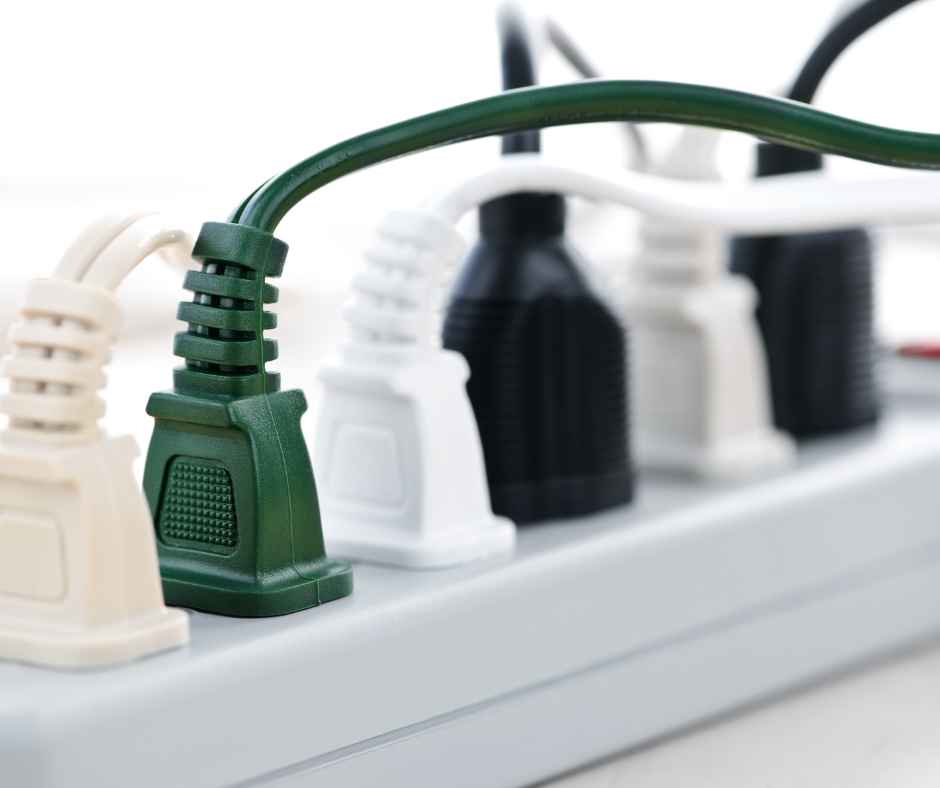
It is a common sight in many Northern Virginia homes: a tangle of power strips behind the TV or under the desk. While these strips are great for adding extra outlets, relying on them as your only line of defense is a risky strategy. Most people don’t realize that the average power strip is only rated to handle a certain amount of energy, measured in joules. Once a strip has absorbed a significant surge, or several smaller ones, its protective capabilities are gone. It still provides power to your devices, but it is no longer protecting them. In essence, it becomes just a very expensive extension cord.
Furthermore, power strips are “point-of-use” devices. They can only protect what is physically plugged into them. This leaves some of the most expensive systems in your Fairfax or Manassas home completely exposed. You cannot plug your HVAC system, your water heater, or your recessed LED lighting into a plastic strip from a big-box store. A whole-home system is installed directly into your main electrical panel, stopping the surge at the source before it ever enters your home’s internal wiring.
Consider these limitations of standard surge strips compared to a professional whole-home solution:
- Limited Coverage: Strips leave hardwired appliances like ovens, dishwashers, and well pumps completely unprotected.
- Joules Exhaustion: Most strips do not have an indicator light to tell you when their surge protection has been “used up” by previous spikes.
- Lower Voltage Threshold: Cheaper strips often allow a significant amount of “let-through” voltage to reach your electronics before they actually trip.
- Fire Hazards: Overloaded power strips are a leading cause of residential electrical fires, especially in older homes with outdated wall outlets.
- Single Path Protection: Strips only protect the power line; surges can also enter your home through cable lines or telephone lines.
By relying solely on strips, you are playing a game of chance with your most valuable assets. A whole-home surge protector works in tandem with high-quality strips to create a “tiered” defense. The main unit handles the heavy lifting by diverting large external surges to the ground, while the strips handle any minor residual interference. This two-layer approach is the gold standard for electrical safety in a modern, tech-heavy household.
Peace of Mind During the Northern Virginia Storm Season
In the transition between spring and summer, Northern Virginia often becomes a corridor for intense atmospheric activity. From the heavy thunderstorms that rattle the windows of historic homes in Manassas to the unpredictable “downbursts” that can drop trees across power lines in Fairfax, our local climate is notoriously hard on the electrical grid. When a storm hits, the sudden loss and immediate restoration of power is the most dangerous time for your home. As the grid tries to stabilize, the rush of electricity can be far more than your devices were built to handle. Having a whole-home surge protector means you don’t have to go racing through the house unplugging your computers and appliances every time you hear a rumble of thunder.
While the surge protector does the heavy lifting at the electrical panel, there are other ways you can protect your home during our local storm season. Here are some essential steps to hard-proof your home against electrical events:
- Install a “Type 1” or “Type 2” Surge Protector: These are professional-grade units installed at the main breaker box that divert thousands of volts safely into the ground.
- Check Your Grounding System: A surge protector is only as good as the ground wire it is connected to. An electrician should verify that your home’s grounding rod is properly installed and not corroded.
- Protect Coaxial and Ethernet Lines: Surges don’t just travel through power outlets; they can enter through your cable box or internet modem.
- Inspect Your Main Breaker: Ensure your main shut-off is in good working order so you can manually cut power if you see downed lines near your property.
- Schedule a Post-Storm Inspection: If your home has taken a significant electrical “hit” or a nearby transformer blew, it is wise to have a professional check for any scorched wires or compromised breakers.
Providing this level of protection is an investment in your home’s long-term resilience. Instead of worrying about whether your expensive smart oven or home theater system will survive the night, you can rest easy knowing that your “gatekeeper” is on duty at the panel. It turns a potential electrical disaster into a non-event, allowing you to focus on keeping your family safe and comfortable until the weather clears.
A Simple Solution for a Complex Home
Your Northern Virginia home is likely the most significant investment you will ever make. In an era where every room is filled with sensitive technology, leaving your electrical system exposed to the whims of the weather and the local power grid is a risk you don’t have to take. Whole-home surge protection is a “set it and forget it” solution that delivers a significant return on investment by extending the life of your appliances and preventing catastrophic damage. It is the kind of upgrade that pays for itself the very first time a storm rolls through Manassas or Fairfax.
At Beacon Home Services, we believe in proactive care for your home. We live and work in this community, so we know exactly what our local power grid puts your wiring through. Our team of expert electricians can quickly install a high-quality surge protection system that covers your entire house, from the basement to the attic. Contact us today to secure your home and protect the high-tech heart of your household for years to come.
FAQ: Surge Protection Questions for Manassas and Fairfax
Does a whole-home surge protector stop lightning?
While these units can handle the secondary surges caused by nearby strikes, no device can 100% guaranteed protection against a direct, head-on lightning strike. However, they provide the best possible defense against the vast majority of storm-related events.
How long do these units usually last?
A typical whole-home surge protector lasts between five and ten years. Many modern units have an indicator light or an audible alarm that will let you know when the internal components have been “exhausted,” and the unit needs to be replaced.
Will I still need to use power strips?
Yes. For your most sensitive electronics, such as high-end PCs or gaming consoles, we still recommend using a high-quality power strip. This creates a “tiered” defense where the whole-home unit handles the big surges and the strip handles any minor noise.
Can I install a surge protector myself?
Because this requires working inside the main electrical panel and connecting to the main breakers, this should always be done by a licensed electrician. It involves a high risk of electrical shock if not handled correctly.
Is this upgrade required by law?
The National Electrical Code was recently updated to require surge protection in many new residential constructions and for certain panel upgrades. Even if your older home isn’t legally required to have one, it is highly recommended for safety and appliance longevity.